
Archives by date

You are browsing the site archives by date.

Spending quality time with your loved-ones

Spending quality time with your loved-ones

We spend a lot of time working on improving ourselves — building strength, learning new skills, becoming more resilient. But there’s one element of well-being that often gets overlooked: our relationships.

Spending quality time with the people we love — family, friends, partners, even supportive communities — is as essential for our health as regular exercise. 

At Kinetics NJ, we don’t just train bodies — we train humans. And humans thrive when they feel connected.


Connection is built into our biology

Humans are wired for connection. When we spend meaningful time with people we care about, powerful things happen in our brain and body.

Positive social interactions can help:

  • Reduce stress by lowering cortisol levels
    • Improve mood through the release of dopamine and oxytocin
    • Strengthen emotional resilience during difficult moments
    • Support long-term health and longevity

Connection acts almost like a regulator for our nervous system. A good conversation, shared laughter, or even quiet companionship can help shift the body from a state of tension to one of relaxation. From a feeling of danger to one of safety.


Quality time means being present

Quality time doesn’t require elaborate plans or big events. Most of the time, it’s the simple moments that matter most.

Quality time can look like:

  • Sharing a meal without distractions
  • Taking a walk with a friend
  • Calling a family member just to check in
  • Playing with your kids
  • Sitting down for coffee and a real conversation

The key ingredient is presence. Being there, listening, and engaging in the moment.

In a world full of notifications and distractions, giving someone your full attention is one of the most valuable things you can offer.


Connection strengthens everything else

Strong relationships don’t just make life more enjoyable — they support everything else we try to improve.

People with strong social support systems are more likely to:

  • Stay consistent with healthy habits
    • Recover faster from stress
    • Maintain motivation when challenges appear
    • Experience greater overall life satisfaction

When you feel supported, growth becomes easier.

It turns out that well-being is rarely a solo project.


Now it’s your turn

Strengthen your connections with one small action today:

  1. Schedule a moment. Reach out to someone you care about and set aside time this week to talk, walk, or share a meal.
  2. Be fully present. Put the phone away and give your attention to the conversation.
  3. Combine movement and connection. Invite a friend or family member for a walk, workout, or stretch session together.

You might be surprised how much better both your mind and body feel afterward.

Call to action

At Kinetics NJ, we believe fitness goes beyond sets and reps. It’s about building a stronger life — physically, mentally, and socially.

If you want to train in an environment where support, accountability, and community are part of the process, reply to this email or send us a text at 732-314-3086. Through Personal Training and high-accountability Small Group Training, we help you build strength, resilience, and a community that supports you every step of the way.

Because progress is powerful — but progress shared is even stronger. 💪
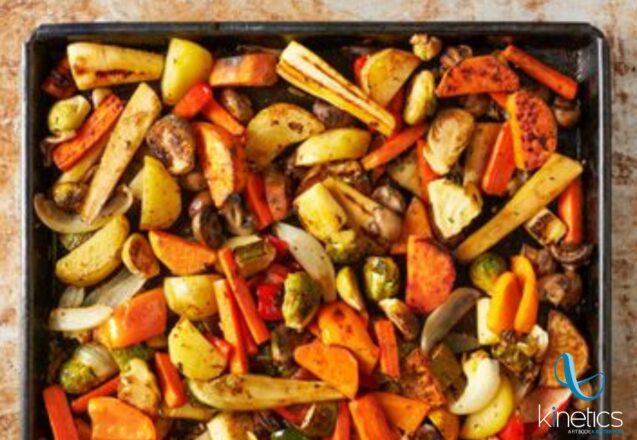

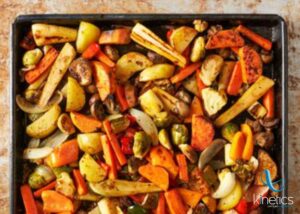
Crispy Baked Vegetable Fries

Crispy Baked Vegetable Fries

Ingredients (serves 2–3)

  • 2 medium carrots, peeled and cut into fries
  • 1 medium sweet potato, peeled and cut into fries
  • 1 zucchini, cut into sticks
  • 1–2 tsp olive oil (or avocado oil)
  • ½ tsp garlic powder
  • ½ tsp smoked paprika (optional)
  • ¼ tsp black pepper
  • ¼ tsp salt (or to taste)
  • Optional: pinch of cayenne for heat

Instructions

  1. Preheat oven to 425°F (220°C) and line a baking sheet with parchment paper.
  2. Toss veggies: In a large bowl, combine all cut vegetables, oil, and seasonings. Toss well so everything is coated.
  3. Arrange on baking sheet: Spread fries in a single layer, leaving space between sticks for crispiness.
  4. Bake: 20–25 minutes, flipping halfway through, until golden and crispy at the edges.
  5. Serve: Sprinkle with fresh herbs (like parsley or thyme) or serve with a vegan dipping sauce (ketchup, sriracha mayo, or tahini).

Tips for Extra Crispy Fries:

  • Pat veggies dry before tossing with oil.
  • Don’t overcrowd the baking sheet—use two sheets if needed.
  • Toss fries halfway through baking for even crispiness.
  • Use cornstarch or chickpea flour (1 tsp per cup veggies) for a slightly crunchier coating.

Nutrition Estimate (per serving, 1 cup fries)

Calories: 120 kcal, Protein: 2 g, Fat: 3 g, Carbs: 22 g, Fiber: 4 g, Sugar: 7 g


Strong Anywhere: Travel-Proof Resistance Training

Strong Anywhere: Travel-Proof Resistance Training

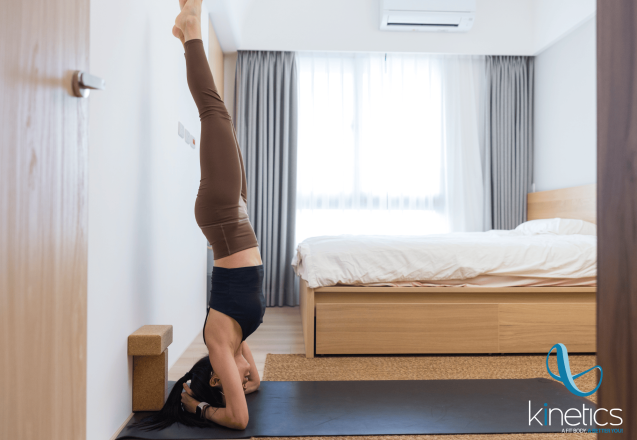
Travel doesn’t have to mean pressing pause on your strength gains. Whether you’re away for work or on vacation, your body is the most portable gym you’ll ever own.

At Kinetics, we remind our members of one key principle:
Consistency always trumps location.

You don’t need a squat rack, fancy machines, or a perfect setup to maintain strength. With smart bodyweight exercises and a little creativity, you can stay strong anywhere.

Bodyweight training is incredibly effective when done with intention. It builds strength, stability, mobility, and coordination—exactly the qualities we train for in the gym.

Some travel-friendly staples:

  • Squats & split squats → lower body strength and joint stability
  • Push-ups (wall, incline, or floor) → chest, shoulders, core
  • Glute bridges & hip thrusts → posterior chain activation
  • Planks & dead bugs → core strength and spinal control

By slowing down the tempo, adding pauses, or increasing reps, you can make these movements just as challenging as gym-based exercises.


Minimal Equipment, Maximum Results

A few simple tools can dramatically expand your options:

Resistance bands
Lightweight, packable, and powerful. Bands are perfect for rows, presses, lateral walks, and assisted stretches.

A sturdy chair or bench
Great for step-ups, Bulgarian split squats, triceps dips, incline push-ups, or single-leg balance work.

A towel or suitcase
Isometrics, carries—sometimes the simplest tools create the biggest challenge.


Short, Simple, and Consistent

When you’re traveling, workouts don’t need to be long to be effective.
15–30 minutes of focused resistance training can:

  • Preserve muscle mass
  • Maintain strength patterns
  • Keep joints moving well
  • Reinforce the habit of training

Skipping workouts often isn’t about lack of equipment—it’s about overthinking the plan.

The best part? At Kinetics NJ we offer virtual classes, and our expert instructors tailor every virtual class to your environment, suggesting creative adaptations based on the equipment you have on hand, so you can take your workout anywhere!


Now it’s your turn 

Planning to travel? Pack a resistance band and your workout shoes, then choose a go-to routine you can do anywhere:

  • 3–4 exercises
  • 2–4 rounds
  • 20–30 minutes max

Commit to consistency, not perfection.


Call to Action

If you want help building a travel-ready strength plan that fits your goals, lifestyle, and schedule, reply to this email or send us a text at 732-314-3086.
The Kinetics NJ coaching team will help you stay strong—no matter where life takes you. 💪


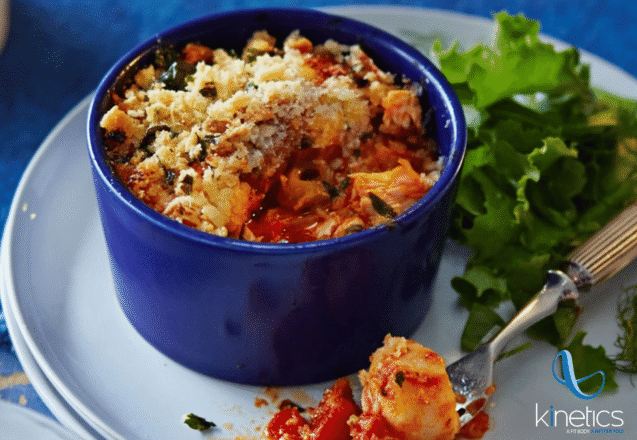
Mediterranean Fish Gratins

Mediterranean Fish Gratins

Adapted from BBC Good Food

The dish is baked until bubbling and golden, creating a comforting seafood gratin with bright Mediterranean flavors.

Ingredients

3 tablespoons olive oil
1 large onion, thinly sliced
1 fennel bulb (about 250 g), trimmed and thinly sliced
3 large garlic cloves, finely sliced
1 heaped teaspoon coriander seeds, lightly crushed
120 ml white wine
2 × 400 g cans chopped tomatoes
A good pinch of saffron
1 bay leaf
1 tablespoon fresh lemon juice
1 small bunch parsley leaves roughly chopped
1 kg mixed skinless fish fillets (such as cod, haddock, hake or pollock), cut into chunks
75 g finely grated Parmesan cheese
45 g panko or coarse dried breadcrumbs
Freshly ground black pepper
Green salad, to serve (optional)

Instructions

  1. Heat the olive oil in a large wide saucepan over medium heat. Add the onion, fennel, garlic and crushed coriander seeds and cook gently for about 15 minutes, stirring occasionally, until the vegetables are soft and lightly golden.
  2. Add the white wine and cook for 2–3 minutes to allow the alcohol to evaporate slightly. Stir in the chopped tomatoes, saffron and bay leaf. Season lightly with salt and pepper, bring to a gentle simmer and cook for about 12–15 minutes, stirring occasionally, until the sauce thickens slightly.
  3. Stir the lemon juice and most of the chopped parsley into the tomato mixture. Add the fish pieces and gently mix to coat them in the sauce.
  4. Cover the pan and simmer gently for about 4 minutes, stirring once very carefully so the fish keeps its shape. The fish should be just starting to cook but still slightly underdone.
  5. Preheat the oven to 220°C. 
  6. Spoon the fish and sauce mixture evenly into six small ovenproof gratin dishes or a medium baking dish.
  7. In a small bowl, combine the grated Parmesan, breadcrumbs, remaining parsley and a little black pepper. Sprinkle the mixture evenly over the fish.
  8. Bake for about 18–20 minutes until the topping is golden brown and the sauce is bubbling around the edges. Let the gratin rest for a few minutes before serving.


Nutrition facts per serving (1 gratin portion, approximately 320 g / 11.3 oz):

Calories 398 kcal, Fat 17.6 g, Carbohydrates 15.2 g, Dietary Fiber 3.1 g, Sugars 6.8 g, Protein 41.5 g, Sodium 612 mg


How to make your gut happy? It’s Not Diet Alone

How to make your gut happy? It’s Not Diet Alone

We’ve all heard it: “You are what you eat.”
And yes—what you eat matters. But how much you eat. How you eat. When you eat. How you sleep. How you move. Even how you breathe. All of these pieces work together, and one of the biggest places they intersect? Your gut.

Not all microbes are villains. In fact, your gut is home to trillions of beneficial bacteria that play a key role in immune strength, stress regulation, inflammation control, energy production, resilience—both physical and mental.


Food Is Important—But So Is How You Eat

Portion awareness: Consistently overeating—even healthy foods—can stress digestion and metabolism.

Eating pace: Slowing down helps improve digestion, blood sugar control, and satiety signals.

Timing: Irregular eating patterns and late-night meals can disrupt gut rhythms and sleep quality.

YOUR GUT THRIVES ON RHYTHM AND CONSISTENCY.


Movement: How physical activity directly influences your gut microbiota

Exercise doesn’t just shape muscles—it reshapes your gut. Research shows that sedentary people who begin to exercise experience beneficial changes in their gut microbiota by way of an increase in healthy bacteria diversity and abundance.

And here’s what’s especially exciting:

Changes in the microbiome can begin within just 2 weeks of starting regular physical activity.

The longer you stay consistent, the greater the benefits.

When exercise interventions last longer than 8 weeks, we see a healthier, more resilient gut ecosystem.


Consistency Beats “On and Off” Training

There’s a catch—and it’s an important one.

Research suggests that if someone returns to a sedentary lifestyle, many of the positive gut changes can revert within about 3 weeks.
However, individuals who already live active lifestyles don’t experience significant losses when they briefly reduce training—another reminder that habitual movement matters more than short bursts.


Not All Exercise Is Created Equal – What the science says

Type matters.

The biggest improvements in gut biodiversity were seen when aerobic exercise was combined with resistance training, compared to aerobic activity alone. 

Intensity matters too.

Moderate-intensity exercise led to greater gut biodiversity than low-intensity activity.

Interestingly, extremely intense exercise didn’t outperform moderate levels—suggesting that more isn’t always better

Frequency matters most of all.

2–3 sessions per week showed minimal microbiome changes.

4–5 sessions per week of ~30 minutes significantly improved gut biodiversity.

Exercising more than 5 times per week increased biodiversity even further.

This sweet spot aligns perfectly with the kind of balanced, sustainable training approach we prioritize at Kinetics.


The Takeaway

Your gut loves regular, moderate, varied movement.
Consistency over time—not extremes—creates lasting internal change.


Now it’s your turn 

Pick two habits to support your gut:

– Eat meals at consistent times

– Avoid late-night eating 

– Take 2 minutes to breathe slowly through your nose before and after meals

– Sit down for at least one meal without screens and slow your pace

– Move your body for at least 30 minutes 4 to 5 days this week, aiming for moderate intensity


Call to Action

If you want help building a routine that supports your workouts and your long-term health—from the inside out—reply to this email or text us at 732-314-3086.
The Kinetics NJ team is here to help you move better, feel stronger, and support your body where it matters most. 💪🦠


High-Protein Post-Workout Vegan Italian Ice

High-Protein Post-Workout Vegan Italian Ice

Ingredients (4 servings)

  • 1 cup strawberries
  • ½ cup fresh lemon juice
  • 1 cup coconut water (for electrolytes)
  • 2 tablespoons maple syrup or agave (optional)
  • 1 teaspoon lemon zest
  • Pinch of sea salt
  • 1 scoop vanilla or unflavored vegan protein powder (pea or pea/rice blend works well)

Instructions

  1. Blend: Add strawberries, lemon juice, coconut water, maple syrup, lemon zest, salt, and protein powder to a blender. Blend until completely smooth.
  2. Strain (optional): If you prefer a smoother Italian ice, strain out strawberry seeds.
  3. Freeze: Pour the mixture into a shallow dish and place in the freezer.
  4. Scrape for texture: Every 30 minutes, scrape the mixture with a fork to create the classic fluffy Italian ice texture.
  5. Serve: After 3–4 hours, scoop into cups and enjoy.

Nutrition Facts (Per serving)

Calories ~60 kcal, Protein ~5 g, Carbohydrates ~11 g, Total Sugars ~7 g, Fiber ~1 g, Fat 

~0.5 g, Sodium ~80 mg, Vitamin C, ~40% Daily Value, Potassium ~150 mg


Why the Last 10 Pounds Won’t Budge 

Why the Last 10 Pounds Won’t Budge 

If you’ve ever tried to lose weight, you probably noticed something frustrating.

The first 10 pounds come off fairly quickly…but the last 10 pounds seems impossible to lose.

At Kinetics NJ, we hear this a lot. You’re eating better, exercising regularly, and staying consistent — but the scale stops moving.

The reason has a lot to do with how the body works.

When you lose weight, your body naturally starts using less energy (calories) than it did before. In simple terms, a smaller body needs less fuel. Your body also tries to protect its energy stores, which can slow fat loss over time.

This is normal biology — not a lack of discipline.

At this stage, many people think the answer is more cardio or eating much less food. 

Unfortunately, that can sometimes make things harder. Eating too little or doing too much cardio can cause the body to lose muscle, which slows your metabolism even more.

This is where strength training becomes extremely important.

Strength training helps build and maintain muscle. Muscle tissue burns more calories than fat, even when your body is at rest. The more muscle you maintain, the more efficiently your body uses energy throughout the day.

For adults, this matters even more. As we get older, we naturally lose small amounts of muscle each year if we don’t train. Losing muscle can make it easier to gain fat and harder to lose weight.

Regular strength training helps by:

  • Keeping your metabolism stronger
    • Helping your body burn more calories
    • Improving strength and energy
    • Supporting healthy bones and joints
    • Making long-term weight control easier

Nutrition also plays a big role. A healthy diet that includes enough protein, vegetables, healthy fats, and quality carbohydrates helps your body recover from workouts and keeps your energy steady.

The goal is not extreme dieting — it’s consistency.

When you combine healthy eating with regular strength training, you give your body the best chance to burn fat while staying strong.

If the last 10 pounds are taking longer than expected, don’t get discouraged. Often your body is still improving in important ways — building muscle, increasing strength, and becoming healthier overall. Your best course of action is to stay consistent, keep lifting, and fuel your body well. Progress is still happening, even if the scale doesn’t show it.

Now it’s your turn 

If weight loss is your goal and the scale isn’t moving, keeping a progress journal could be the game changer that you need. 

This week record your workouts and determine if you are meeting your training targets. You can use an app like my fitness pal or going old school and just writing it down.

At the very bare minimum you should be accumulating 150-180 minutes of intermediate to challenging exercise weekly. 

For nutrition, log your food and identify if you are eating enough, varied, quality, wholesome foods. Record your water intake; are you getting at least half your body weight in ounces? 

If after two weeks the scale hasn’t moved and you are not sure what to do, don’t get too upset, instead reach out to us here at Kinetics NJ.  

We will have you come in for one of our free consultations. During your consultation we will talk through your next best steps to get the scale to move in a healthy way. 

Call to action 

To schedule your free consultation do email us here or text us at 732-314-3086. We would be happy to support you in learning how to move the scale once and for all.


Baked Chicken Nuggets with Honey-Glazed Veggies

Baked Chicken Nuggets with Honey-Glazed Veggies

These baked chicken nuggets are a healthier, family-friendly twist on a classic favorite. Crispy on the outside, tender on the inside, and paired with sweet, roasted carrots, they make a perfect meal for a special weeknight.

Ingredients
1 Tablespoon olive oil (for pan)
2 boneless, skinless chicken breasts (about 1–1¼ pounds)
½ teaspoon kosher salt
¼ teaspoon black pepper
1 egg
¼ cup water
½ cup panko breadcrumbs or whole-grain breadcrumbs
½ cup grated Parmesan cheese
1 teaspoon dried oregano
⅛ teaspoon cayenne pepper
2 medium carrots, peeled and sliced
10 Brussel sprouts, cut into halves
1 Tablespoon olive oil (for carrots)
1 Tablespoon honey
1 teaspoon Herbes de Provence
½ teaspoon kosher salt (for carrots)
¼ teaspoon black pepper (for carrots)

Instructions

  1. Preheat the oven to 375°F and lightly coat a baking sheet with 1 Tablespoon olive oil.
  2. Cut the chicken into small, even cubes and sprinkle with ½ teaspoon salt and ¼ teaspoon black pepper.
  3. In a small bowl, whisk together the egg and ¼ cup water until combined.
  4. In a medium dish, combine the panko or breadcrumbs, grated Parmesan, dried oregano, and cayenne pepper.
  5. Dip each piece of chicken first into the egg mixture, then roll in the crumb mixture to coat evenly, and lay onto the pre-heated baking sheet without crowding.
  6. In a separate small bowl, combine the carrot slices, Brussel sprouts, 1 Tablespoon olive oil, honey, Herbes, ½ teaspoon salt, and ¼ teaspoon black pepper, tossing to coat.
  7. Arrange the vegetables on the baking sheet next to the coated chicken nuggets.
  8. Bake everything in the preheated oven for about 15 minutes, until the chicken is no longer pink inside and the vegetables are tender and lightly caramelized.


Nutrition facts per serving (1 plate, 350 g / 12.3 oz):

Calories 448 kcal, Fat 16.1 g, Carbohydrates 30.2 g, Dietary Fiber 5.6 g, Sugars 10.4 g, Protein 42.3 g, Sodium 812 mg.